Aloha, Friend. My March was dominated by four critical matters: the war in Iran; the destructive Kona Low storms; immigration enforcement reform; and my work as a member of our House Appropriations Committee on our federal government’s upcoming Fiscal Year 2027 budget. The unacceptably high cost of living continued as my main priority throughout. In all of this I was guided by your ongoing input, especially your many responses to my March 1st constituent survey link. I want to report back to you on these matters and as always ask for your ongoing guidance.Iran. President Trump’s war on Iran is now in its 32nd day. Contrary to the administration’s statements, the war is not going as hoped. The desired regime change has not happened, nor has the destruction of Iran’s military capabilities. We have tragically lost our own and depleted our overall defense capabilities. Iran has successfully jeopardized the world’s oil supply and shaken the global economy, and our skyrocketing gas and other prices are a direct result. One doesn’t go to war without severe anticipated and unanticipated consequences, and all of that is happening.I said on February 28th here when this war started and in my March 1st enewsletter to you, and say again: Iran cannot be allowed to have nuclear weapons and the means to deliver them against us, and so there may be circumstances under which war would be our only option. But the President has still not laid out that case, still not laid out clear goals, a clear path to achieving those goals, and a clear exit strategy to avoid an endless, expanding conflict with expanding consequences, still not spoken to the realities of this commitment on our broader defense to our more severe challenges. And it is very clear that there was no imminent threat that required immediate action.Under our Constitution, Congress is the check and balance against any President taking our country to war alone. President Trump took us to war without the authorization of Congress after a full explanation of the realities, plan and risks. That is a highly dangerous precedent, and I voted for a resolution stating that this war could not continue without Congressional authorization.This was what you told me in my recent constituent survey. I asked whether the President requires Congressional authorization to wage war on Iran. Your answers were: 72% yes; 14% no because of an imminent threat of attack by Iran on our country; and 14% no because the President does not require Congressional authorization to attack Iran. I asked whether we should continue or stop the attacks on Iran; 36% said continue and 64% said stop. So what happens now? First, my current Congressional majority colleagues have refused to require Congress’ authorization for the President to continue this war, and so the President continues to act unilaterally. Second, the practical reality is that neither side can continue this war at this pace indefinitely, and so, absent some clear win soon, it will settle into a different conflict or agreement, which the President is clearly trying to achieve. Third, this is a very dangerous phase in which there is a great temptation to make the same mistakes of the past in escalating the war, as the President is clearly threatening, to achieve a clear win or maximize settlement options. Fourth, unless and until this is resolved one way or another (and even for a long time after), the world economy generally and our prices specifically will be disrupted. And fifth, continuing the war will soon require Congressional refunding, and so all of this must and will be debated and decided in Congress one way or the other. These are uncertain answers, but this is a highly uncertain time and we must navigate it all under our Constitution, laws and principles as best we can. I especially welcome your continued input.
Representative Ed Case

March 31, 2026

Aloha!

Aloha, Friend. 


My March was dominated by four critical matters: the war in Iran; the destructive Kona Low storms; immigration enforcement reform; and my work as a member of our House Appropriations Committee on our federal government’s upcoming Fiscal Year 2027 budget. The unacceptably high cost of living continued as my main priority throughout.


In all of this I was guided by your ongoing input, especially your many responses to my March 1st constituent survey link. I want to report back to you on these matters and as always ask for your ongoing guidance.


Iran. President Trump’s war on Iran is now in its 32nd day. Contrary to the administration’s statements, the war is not going as hoped. The desired regime change has not happened, nor has the destruction of Iran’s military capabilities. We have tragically lost our own and depleted our overall defense capabilities. Iran has successfully jeopardized the world’s oil supply and shaken the global economy, and our skyrocketing gas and other prices are a direct result. One doesn’t go to war without severe anticipated and unanticipated consequences, and all of that is happening.


I said on February 28th here when this war started and in my March 1st enewsletter to you, and say again: Iran cannot be allowed to have nuclear weapons and the means to deliver them against us, and so there may be circumstances under which war would be our only option. But the President has still not laid out that case, still not laid out clear goals, a clear path to achieving those goals, and a clear exit strategy to avoid an endless, expanding conflict with expanding consequences, still not spoken to the realities of this commitment on our broader defense to our more severe challenges. And it is very clear that there was no imminent threat that required immediate action.


Under our Constitution, Congress is the check and balance against any President taking our country to war alone. President Trump took us to war without the authorization of Congress after a full explanation of the realities, plan and risks. That is a highly dangerous precedent, and I voted for a resolution stating that this war could not continue without Congressional authorization.


This was what you told me in my recent constituent survey. I asked whether the President requires Congressional authorization to wage war on Iran. Your answers were: 72% yes; 14% no because of an imminent threat of attack by Iran on our country; and 14% no because the President does not require Congressional authorization to attack Iran. I asked whether we should continue or stop the attacks on Iran; 36% said continue and 64% said stop. 


So what happens now? First, my current Congressional majority colleagues have refused to require Congress’ authorization for the President to continue this war, and so the President continues to act unilaterally. Second, the practical reality is that neither side can continue this war at this pace indefinitely, and so, absent some clear win soon, it will settle into a different conflict or agreement, which the President is clearly trying to achieve. Third, this is a very dangerous phase in which there is a great temptation to make the same mistakes of the past in escalating the war, as the President is clearly threatening, to achieve a clear win or maximize settlement options. Fourth, unless and until this is resolved one way or another (and even for a long time after), the world economy generally and our prices specifically will be disrupted. And fifth, continuing the war will soon require Congressional refunding, and so all of this must and will be debated and decided in Congress one way or the other. 


These are uncertain answers, but this is a highly uncertain time and we must navigate it all under our Constitution, laws and principles as best we can. I especially welcome your continued input.


Congressman in Appropriations


Kona Low Storms. Our Hawai‘i of course suffered back-to-back generational storms with severe flooding and other damage statewide. I first join in expressing deep gratitude to our armed services, our state and local first responders, non-profits, and volunteers, our communities, my federal, state and county government partners, and really all of us for pulling together to see us through. This is the best of who we are. 


My role in these disasters, as with past disasters including COVID, Red Hill and Maui, is to assure that our federal government is doing everything it can and should to assist us. I especially work through my membership on our House Appropriations Committee’s Subcommittee on Homeland Security, responsible for overseeing and funding federal disaster relief, through the Federal Emergency Management Agency (FEMA) and otherwise. That has been my full focus this month in seeking FEMA assistance for the well over one billion dollars of estimated damage from the storms.


As part of that effort, I joined my Hawai‘i Congressional delegation colleagues in urging the President to support Governor Green’s request for a declaration of a major disaster, which is the first step in gaining major FEMA and other federal disaster assistance. See our letter here. If you or yours have any specific questions or needs, please contact me at ed.case@mail.house.gov or (808) 650-6688.


Homeland Security/Immigration Enforcement. In my February 9th e-newsletter to you, I said, and repeat, that while we must enforce our immigration laws, we cannot do so as our Immigration and Customs Enforcement (ICE) and Customs and Border Protection (CBP) have been doing in Minnesota and elsewhere in our county. For that reason, while I earlier voted to fund the rest of our government, I could not vote to fund the Department of Homeland Security (DHS), through which ICE and CBP are funded, unless and until ICE, CBP and other DHS agencies charged with enforcing our immigration laws are reformed. However, I co-introduced and have advocated for legislation to fund all parts of DHS other than ICE and CPB, to include critical agencies such as the Transportation Security Administration (TSA), Cybersecurity and Infrastructure Security Agency (CISA), and Coast Guard, and have continued to work with like-minded colleagues on both sides of the aisle, through our House Problem Solvers Caucus and otherwise, toward responsible immigration enforcement reform.


Because Congress and the administration have not reformed immigration enforcement and have not separated out ICE and CBP from overall DHS funding, the DHS shutdown has now extended into 46 days, with most of our invaluable DHS employees working unpaid. Last Friday, in one of the most disappointing actions in a very disappointing Congressional year, a small minority in the House, supported by the current Congressional majority, succeeded in blocking a compromise solution the Senate had passed unanimously to fund and reopen all of DHS except ICE and CBP while we continued efforts to reform immigration enforcement. While deeply discouraging, it accelerates the need for immigration enforcement reform, to which I continue to devote my efforts.


Fiscal Year (FY) 2027 Appropriations. The Iran war, Kona Low storms, DHS/immigration enforcement reform impasse and more are just some of the specific critical issues that always arise. But Congress must still deliver on its year-in, year-out responsibilities for running our federal government. Foremost among then, in which I’m deeply involved as a now-eight year member of our House Appropriations Committee, is funding our federal government, which we must do every year.


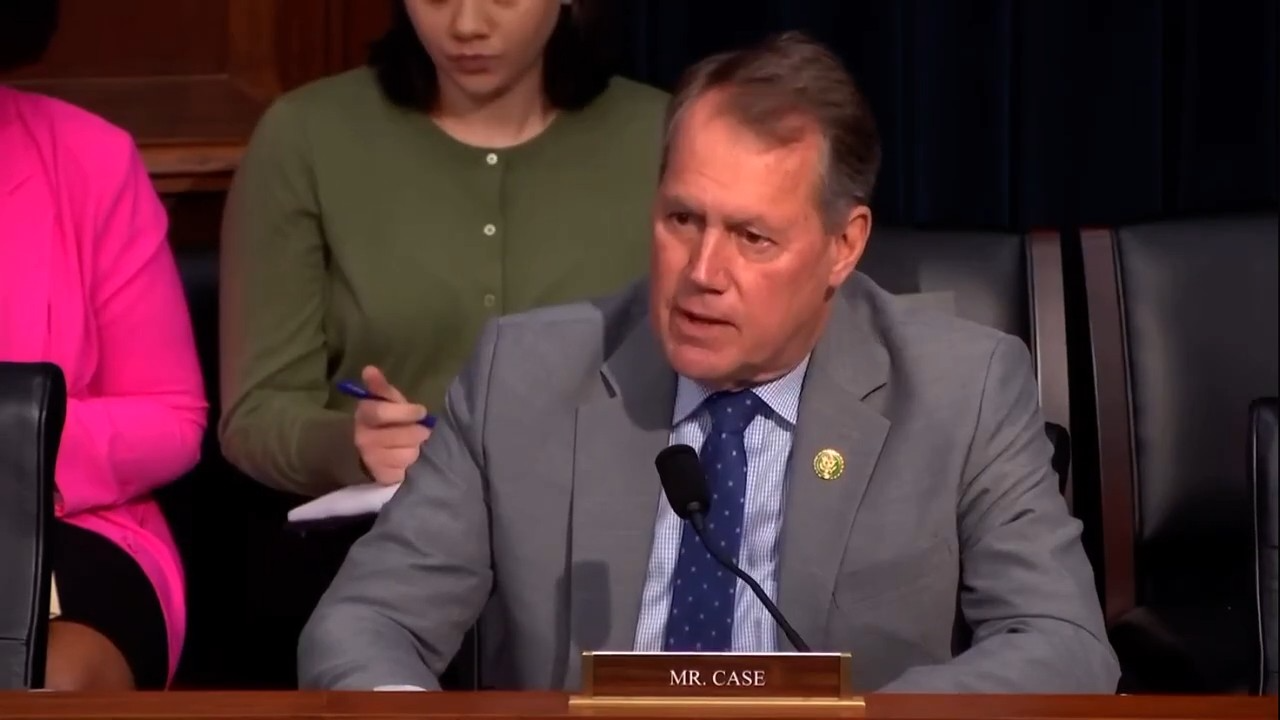
We are now fully into preparing our appropriations (funding) for our FY 2027, which begins this coming October 1st, just six months away. My staff and I have been working on FY 27 in earnest for a good six months already. In this last month, as we do every year at this time, we finalized and filed hundreds of requests for billions of dollars in federal funding to our Hawai‘i for consideration by my Appropriations Committee this cycle. I have also gone into my busiest six months on Appropriations which will dominate the majority of my Congressional time, especially my responsibilities on our Subcommittee on Defense, which covers all of our defense and intelligence communities, and our Subcommittee on Homeland Security.


Cost of Living. Amidst all of this, I remain fully focused on the number one issue for most of us, affordability, as you reconfirmed in my recent constituent survey. From food and gas and housing and health care to child care, education and more, our costs of living, worsened by the Iran war, tariffs, economic doubts, the Jones Act and more, are unacceptably high. I outlined my goals and many of my efforts to make our lives affordable in my December 2025 enewsletter here. I continue all of these and further efforts, and especially welcome your thoughts.


There is much more on my recent activities on my website at case.house.gov. Please let me know of your questions, suggestions and needs at ed.case@mail.house.gov or (808) 650-6688. 


mahalo!


Contact Me

 
IN WASHINGTON, DC
2210 Rayburn HOB
Washington, DC 20515
Ph. (202) 225-2726
IN HONOLULU
1003 Bishop Street
Suite 1110
Honolulu, HI 96813
Ph. (808) 650-6688
 

Email

ed.case@mail.house.gov

https://case.house.gov/contact


Social Media

facebook icon  twitter icon  instagram icon  youtube icon
 
 
Unsubscribe