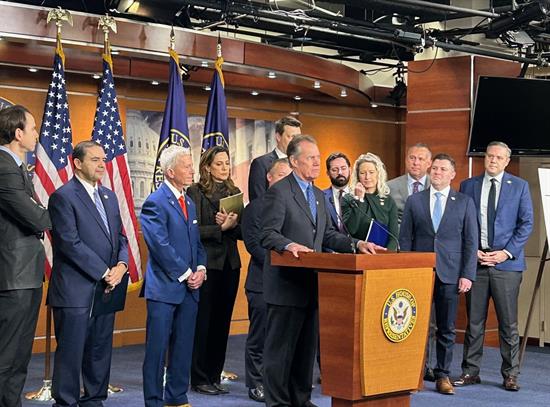
(Washington, DC) – U.S. Representative Ed Case (D-HI-01) today joined 34 House colleagues led by Congressman Josh Gottheimer (D-NJ-05) and Congresswoman Jen Kiggans (R-VA-02) in the release of their Commonground 2025: A Bipartisan Health Care Framework to address the impending expiration of critical premium tax credits for Affordable Care Act (ACA) marketplace enrollees.
“Millions of Americans are facing a crippling increase in their healthcare costs because of Congress’s inability to extend these often literally lifesaving ACA provisions,” said Case during a news conference today at the U.S. Capitol with his colleagues.
Their Bipartisan Health Care Framework would prevent impending drastic increases in premiums in 2026 for the more than 24 million Americans who get their health insurance through the ACA marketplaces including nearly 25,000 Hawai‘i residents. In most cases, the ACA is the only health insurance option available to participants, so the practical effect of its expiration would be not only dramatic premium increases but millions without health insurance.
“The expiration of these credits at year-end would represent an utter failure of a divided Congress to deliver solutions on the real issues facing Americans,” said Case. “Our plan calls for a two-year extension of expiring health insurance premium savings for American families, including a year of the enhanced Premium Tax Credits, with targeted modifications.”
Since the passage of the enhanced premium tax credits, enrollment in ACA plans has increased from 11 million to more than 24 million people. If these enhanced premium tax credits are not extended by December 31, 2025, enrollees could see their premiums jump more than double on average, with some individuals seeing even greater increases.
To address the looming crisis, Case and his bipartisan group have worked behind-the-scenes over the last several months, including throughout the government shutdown which resulted in large part from the failure to address this central issue, to develop a solution they could all support and which would actually be able to pass Congress and be signed into law.
Case continued: “Our bipartisan plan offers a practical, common sense, mainstream solution, and many of its elements enjoy strong bipartisan support. As our plan lays out a two-year process, it also gives Congress the time to develop and legislate the deeper reforms necessary to improve a health care system which is simply too unavailable and unaffordable for too many Americans.”
The current premium tax credit provisions of the ACA expire on December 31st of this year. Congress must pass either a straight extension, or an extension with modifications as the group has proposed, or some other solution, by then, or the large premium increases if not loss of insurance altogether will hit many if not most ACA participants in 2026.
Attachments
· The proposal and the letter to House and Senate leadership explaining it is available here.
· A video of Case’s remarks on the framework is available here.
· Pictures of Case at today’s news conference are also attached.
The group’s common news release is here:
RELEASE: Bipartisan Group of 35 House Members Announce New Health Care Framework “CommonGround 2025”
Addressing Skyrocketing Health Insurance Premiums for American Families
WASHINGTON, D.C. — Today, December 4, 2025, a bipartisan group of 35 total House Members, co-led by Reps. Josh Gottheimer (NJ-5) and Jen Kiggans (VA-2), announced a new health care framework, CommonGround 2025. The bipartisan framework includes a two-year extension of health insurance premium savings for American families, including a year of the enhanced Premium Tax Credits (ePTCs), with targeted modifications, to be voted on by December 18, 2025, in the U.S. Senate and House of Representatives.
The Members backing the framework have also co-signed a letter urging House and Senate leadership to meet with them to discuss the framework and a constructive pathway forward in both chambers.
The framework and letter, co-led by Reps. Josh Gottheimer (NJ-5) and Jen Kiggans (VA-2), are also co-signed by Reps. Adam Gray (CA-13), Juan Ciscomani (AZ-6), Vicente Gonzalez (TX-34), Maria Salazar (FL-27), Darren Soto (FL-9), Mike Lawler (NY-17), Jim Costa (CA-21), Jefferson Van Drew (NJ-2), Josh Riley (NY-19), Tom Kean (NJ-7), Susie Lee (NV-3), Jeff Hurd (CO-3), Jared Golden (ME-2), David Valadao (CA-22), Chris Pappas (NH-1), Ryan MacKenzie (PA-7), Ed Case (HI-1), Carlos Gimenez (FL-28), Maggie Goodlander (NH-2), Monica De La Cruz (TX-15), Sam Liccardo (CA-16), Robert Bresnahan (PA-8), Greg Landsman (OH-1), Don Bacon (NE-2), Jimmy Panetta (CA-19), Kevin Kiley (CA-3), Henry Cuellar (TX-28), Nick LaLota (NY-1), Don Davis (NC-1), Scott Peters (CA-50), Marie Gluesenkamp Perez (WA-3), Hillary Scholten (MI-3), and Tom Suozzi (NY-3).
Find the CommonGround 2025 framework here and below. Find the letter to House and Senate leadership here.

Top-line Summary.
Two-year extension of health insurance premium savings for American families — including a year of the enhanced Premium Tax Credits (ePTCs), with targeted modifications, to be voted on by December 18, 2025, in the U.S. Senate and House of Representatives.
Year One: An extension of the ePTCs, with targeted modifications.
· Extension of the ePTCs for enrollees earning less than 600% of the federal poverty level (FPL) and a phase out of the ePTCs for enrollees earning between 600% FPL and 1000% FPL.
· New guardrails to prevent “ghost beneficiaries” and crack down on fraud, including:
o Implementing the Insurance Fraud Accountability Act to crack down on civil & criminal penalties for fraudulent agents / brokers;
· Extension of open enrollment until March 19, 2026, and requiring HHS to notify qualified individuals of the extension of open enrollment.
· PBM reform (provisions included in the bipartisan Continuing Resolution from December 2024 and featured in the PBM Reform Act and Bipartisan Health Care Act) which:
o Bans “spread pricing” in Medicaid.
- Reforms Medicare Part D by delinking PBM compensation from the cost of medications.
- Promotes transparency for both employers and patients in their prescription drug plans.
Year Two: Continued health insurance premium savings, including more significant reforms, agreed upon and voted on in the U.S. Senate and House of Representatives by July 1, 2026.
Reforms for consideration:
- Option for consideration: Medicare physician fee schedule (from December 2024 CR).
- Boosts the Medicare Physician Fee Schedule.
- Option for consideration: Hospital billing transparency.
- Requires hospitals to disclose prices, including negotiated rates and cash prices.
- Option for consideration: Give Kids A Chance Act (from December 2024 CR).
- Accelerates pediatric cancer treatments and expands access to life-saving therapies for children battling rare diseases.
- Option for consideration: Elimination of zero-dollar premiums with minimum monthly payments, but with need-based hardship support for those who cannot afford this payment.
- Option for consideration: HSA Accounts (Sen. Cassidy proposal).
- Shifts funding that would have paid for the ePTCs to HSA accounts.
Potential Pay-fors.
- Anti-Fraud provisions of IFAA, HOPE Act: not yet scored, but substantial.
- PBM reforms: as delineated in the December 2024 CR.
###